Bachelor’s Hall
Melton Hill is one of the most desirable addresses in Townsville and its desirability was admired from the earliest days of colonial settlement in 1864. From the top of the Hill views could be had of the entrance to Ross Creek, which then encompassed Flagstaff (Pilot) Hill on the western entrance, and the outlying Red Cliff (Redcliffe) Island, better remembered as Magazine Island. Magnetic Island occupied the centre whilst to the east the full expanse of the Strand stretched to Kissing Point, with Many Peaks Range beyond; an entire domain which John Melton Black wished to develop for himself.
JM Black had first explored the environs of Cleveland Bay in May of 1864 having been made aware of its discovery by two of his managers from Woodstock Station. The key ingredient to this discovery was access to and from the Bay via Ross Creek, which was appreciated by his newly acquired partner, Robert Towns: I note what you say about the attempt to founding a port 1
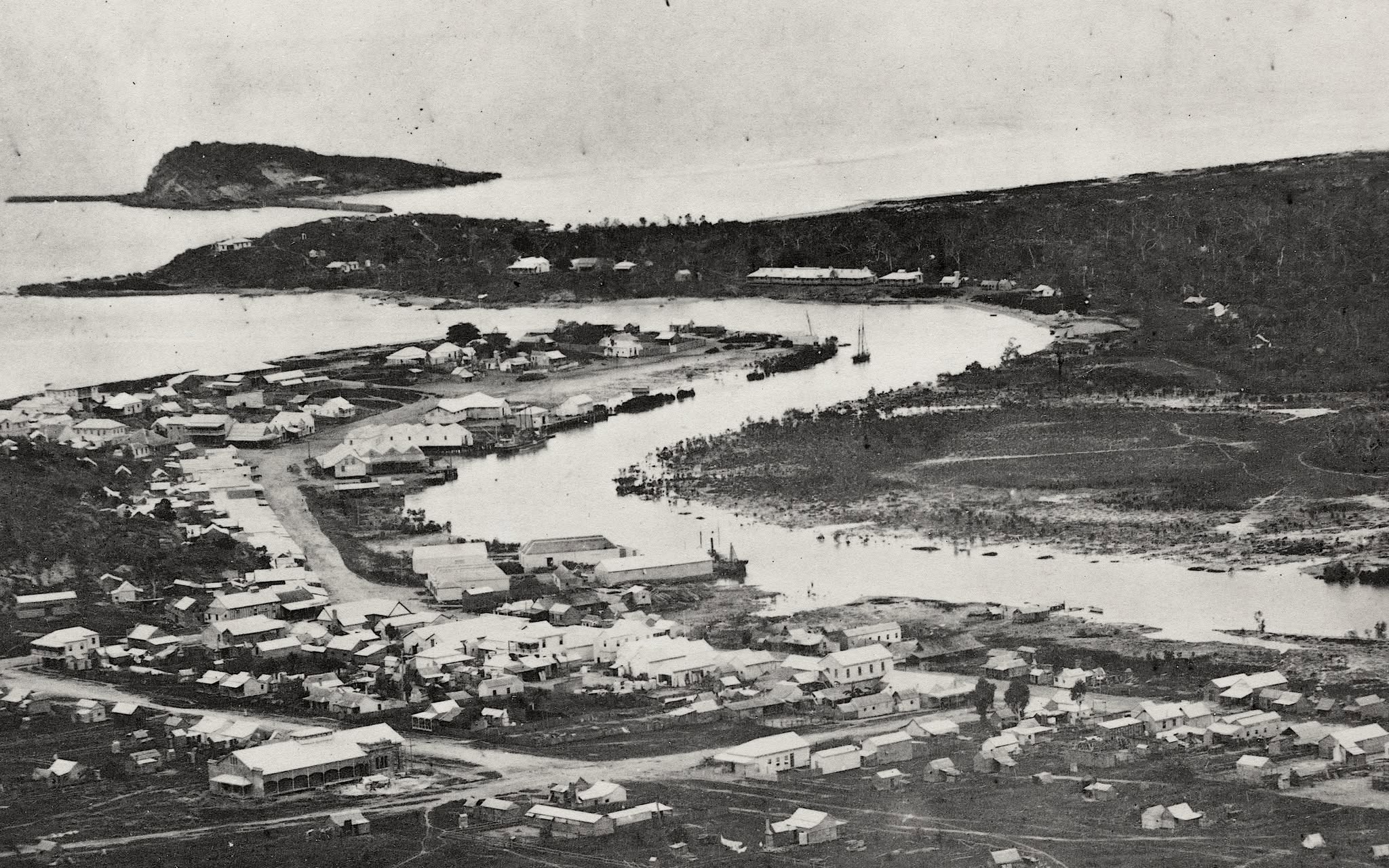 The mouth of Ross Creek as seen from Castle Hill c1880’s. Magazine Island/Red Cliff is seen at the rear and Flagstaff/Pilot Hill on the western side of the Creek
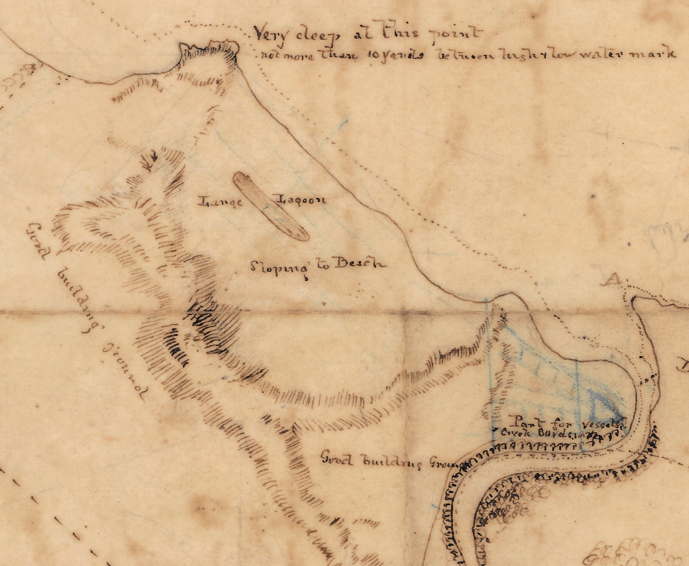
In November of the same year the first group of settlers arrived and set up camp at a site which Black had identified on the map prepared back in May, as a ‘Large Lagoon’. This is the present-day site of Strand Park, and it was from here that some of the men of the first expedition were at once set to work to fell the ti-trees about the lagoon and to saw them into planks. Out of these planks Mr Black’s residence was built on Melton Hill. 2
Only a week or two later Black was making his intentions clear to his partner: The more I see of this place the better I like it, and it is the opinion of all those who have seen it that it will be a most important place….By the way there is one particular allotment on which I propose erecting a private house which I wish for myself alone, and not to go with the partnership. I suppose you will have no objection to my using our power as lessee to secure it, although for myself… the place is situated on a point I have named Point Kennelly after one of the officers of the Native Police.’ 3
Having gazetted a port of entry at Port Hinchinbrook (Cardwell) in May 1864, The Queensland Government was taken by surprise at the swift developments taking place at Cleveland Bay, and it was not until February 1865 that Clarendon Stuart arrived to survey the new township, by which time much of the surveying had been laid out by Black.
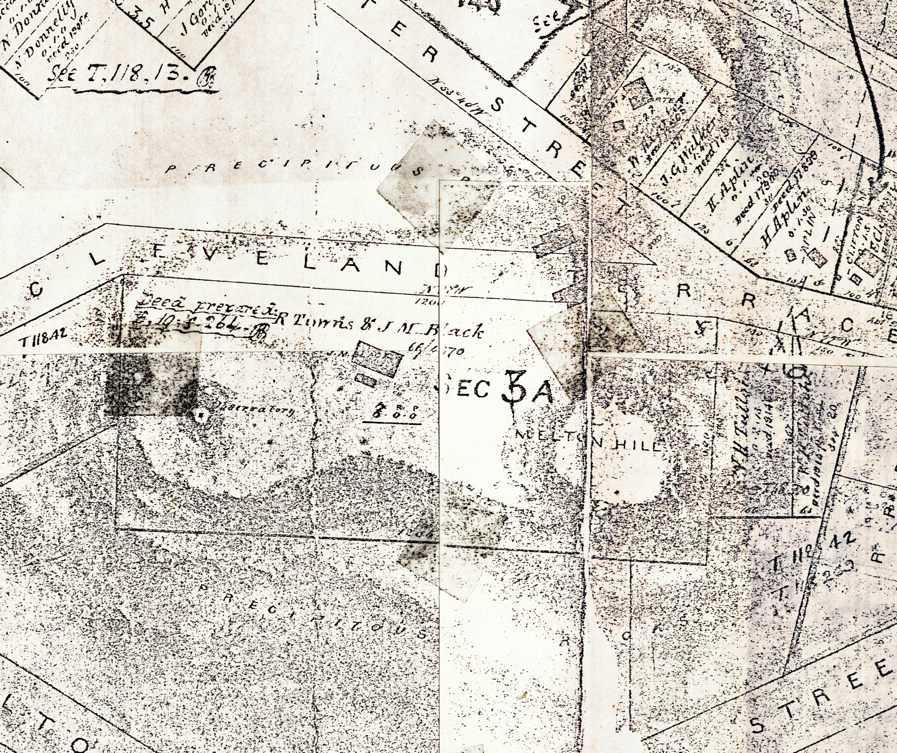
Stuart’s discomfort at having to partition this large block of land at the summit of the hill on behalf of JM Black is evident in the apologetic tone of his report to the Surveyor General: I do myself the honour to draw your attention to the 3a. 0r. 0p measured on the top of the hill and to state that from its proximity to valuable town allotments it might at first sight appear too large a portion to measure, the nature of the ground is so steep and rocky as to render it available only for suburban allotments. I have marked out nothing more on this hill until it shall have met with your approval.4
But the Government’s disapproval was evident when Black wrote to Towns in July that: I endeavoured to obtain the grant of the land on which is erected a private dwelling house on the top of the hill, together with the ground comprising the plateau of the hill, but the Surveyor General considers the position ought to be made a public reserve and, in such case, we would receive full compensation for our improvements.5
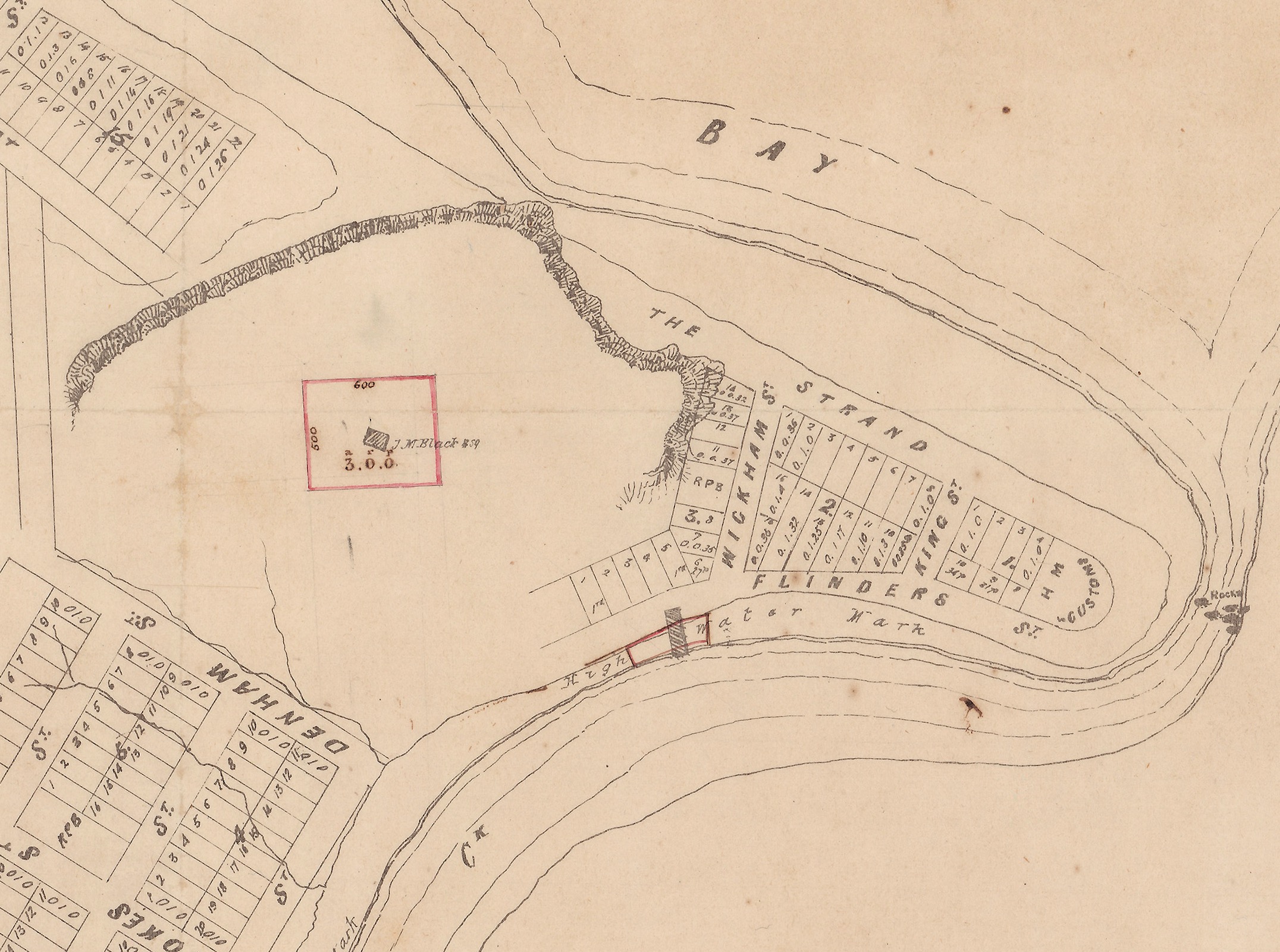 The first survey of Townsville 1865 showing JM Black’s house
and his 3 acres, 0 roods and 0 perch, in splendid isolation
Besides Black’s ambition to own the hilltop site, he had also made numerous requests to the Government for property in lieu of the considerable risk and expense that he had endured in the enterprise of discovering a new port. But the Government were intransigent, making it clear that all land parcels would be up for public auction, to which Black wrote to Towns that: I am very much disgusted at the manner in which we have been neglected by the Government. 6
The success of the land sale of 31st July 1865 brought the partners no comfort as prices soared and left them purchasing some allotments at much higher rates than we intended to pay. Black lamented that: I cannot but express my feeling in this matter and the disgust I entertain towards every member of the Executive for the manner which they have treated us. 7
In the same letter Black is still desperate to secure his private domain: I have asked that the block of ground on which the private residence is built, on the summit of the Hill, may be granted to us without competition. I really think our position ought to be taken into consideration…. The least they can do is give us the grant of the land on the summit of the Hill at a reasonable price.
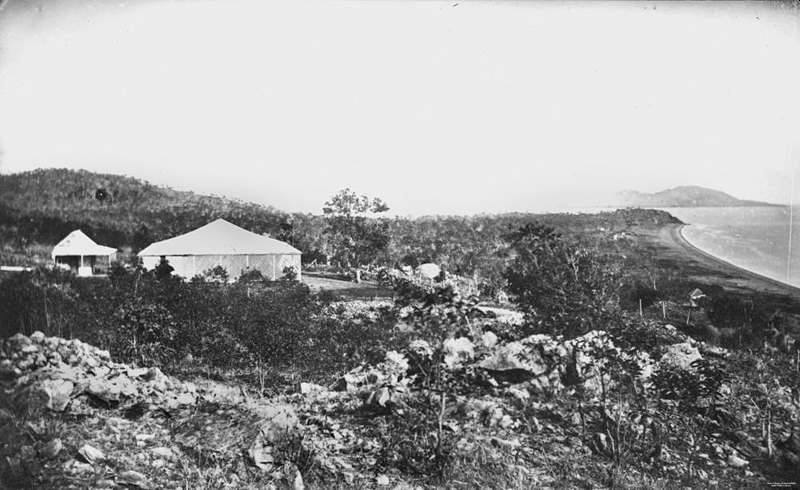
Cape Pallarenda. The kitchen is a separate buiding to the rear.
Photo by Richard Daintree (SLA)
The determined applications by Black and Towns must have had some effect because in January of 1866 the Executive Council announced that the final decision over Towns’ land claims should be held over…pending the further report of the Surveyor-General. And in March they concluded that: In consideration of the Settlement at Cleveland Bay having been developed by the energy of Messrs Towns and Black the Council advise that they be permitted to purchase the wharf sites fronting allotments 2, 3, 4, 5, & 6 Section 3 Township of Townsville for £50 or £10 for each wharf site, also three acres containing improvements valued at £2000 under clause15 “Alienation Act 1860” at £25 per acre as recommended by the Surveyor General. 8
Soon afterwards on the 7th of July the Cleveland Bay Express reported that: Mr. Stuart, District Surveyor, arrived by the Eva and is surveying the hill where the finding of trafficable roads will exercise his engineering skill. By some it is called Prospect Hill, by others Constitution Hill, the Crags and Black Hill. The three latter we strongly object to. We say give it a name.” Which was duly announced as Melton Hill by the end of the month.
And so, the layout of present-day Townsville began to take shape and according to an anonymous traveller it will become a place of first-rate importance…Viewing the position of the place, a more eligible site for a township could not be selected…. Mr. Black’s mansion, when finished, will be a prominent object, as seen from the bay.9
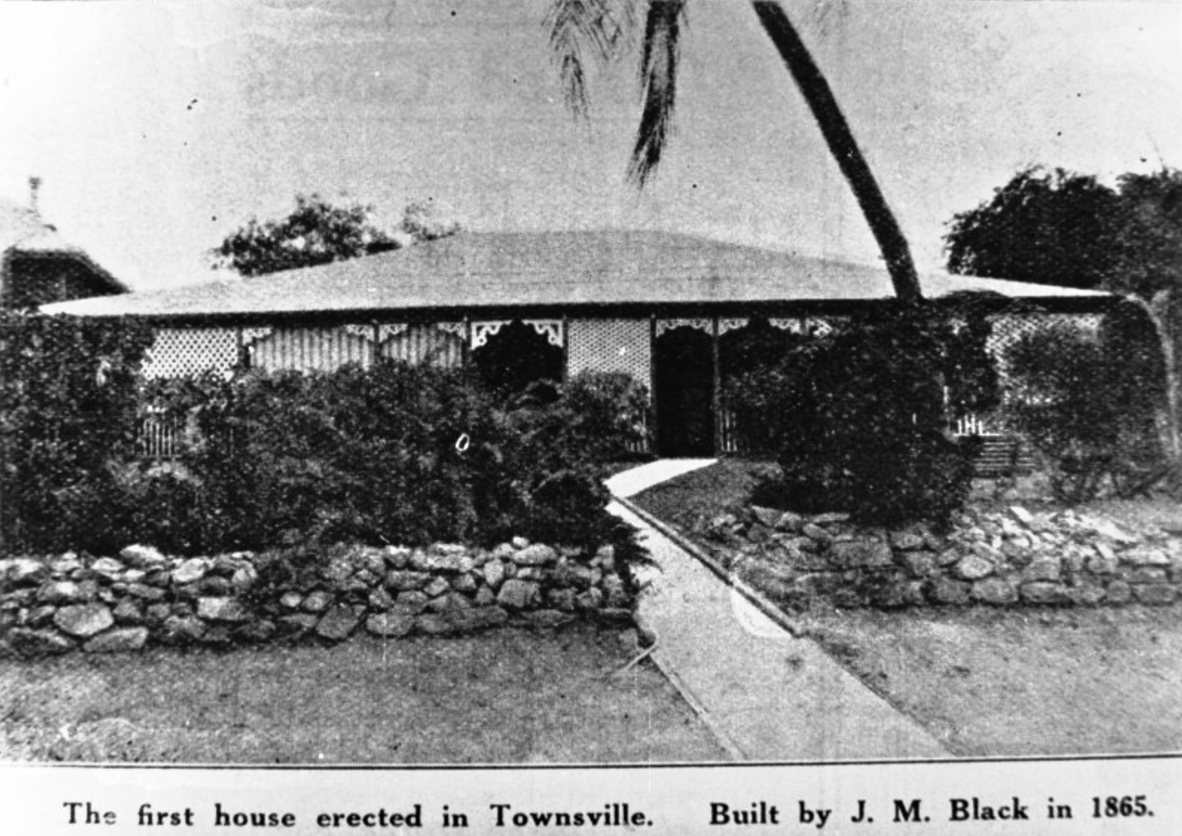 Bachelor’s Hall c1930
1 Towns to Black 29th June 1864. Townsville City Library L. C. PAM 829.61 TOW
2 Townsville Herald December 1887 p 30
3 Black to Towns 21st November 1864, Black MSS (Manion Collection) ITM103550
4 ITM103550 QSA Stuart to Surveyor General April 15th, 1865
5 Black to Towns 11 July 1865 (Manion Collection)
6 Black to Towns 29 July 1865 (Manion Collection)
7 Black to Towns 31 July 1865 (Manion Collection)
8 Executive Minute 7 March 1866 Executive Council 66/43
9 Brisbane Courier, Thursday 21 September 1865, page 2
 Drawing made when the house was dismantled in 1969
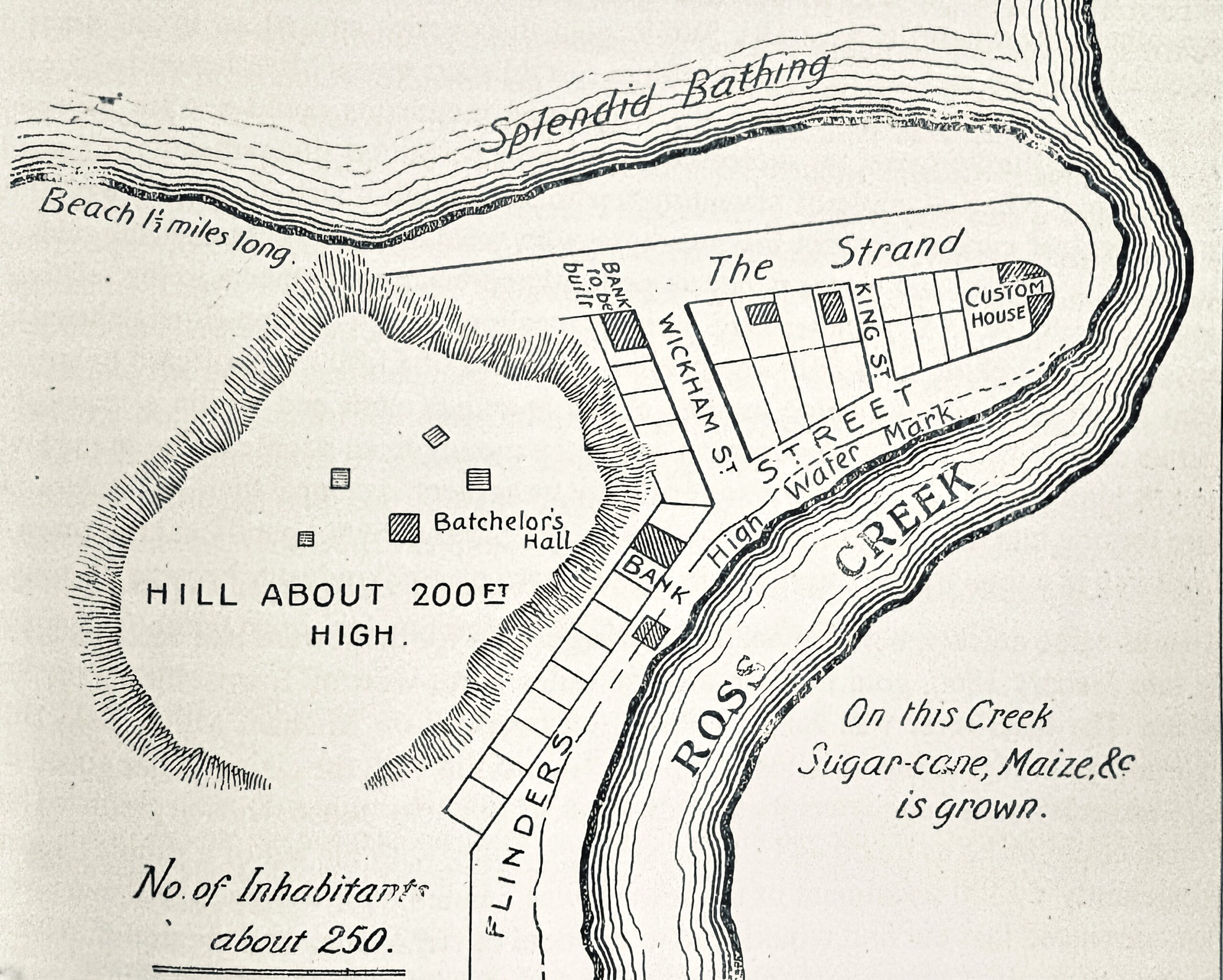
‘Bachelor’s Hall’ was a fashionable term in common use in the 19th century, denoting a room or separate building in which young single men could congregate. The first use of the name for Black’s house appears to be on a map reproduced in April 1925 in Cummins and Campbell’s Magazine, ‘taken from a plan made in 1867.’
Black’s house had four bedrooms and a separate kitchen/pantry brick-built building which also included a bedroom, all of which would indicate that the home had been purpose built for a live-in housekeeper and rooms for Black and his friends. These included, SF Walker, WA Ross, Peter Lauder, Andrew Ball, CS Rowe and at times, young Robert Towns. This arrangement would have been a welcome improvement to the shanty that Black, Ross and Walker were living in situated close to the landing site and described as being ‘fashioned of sheets of iron tied together with strips of rawhide.”
Whilst Black’s relatively isolated house on top of Melton Hill would have been ideal to pursue the Bachelor lifestyle, there are also reasons to think that Black and his colleagues were also intent on having fun. In early 1865 plans were well afoot to open the first hotel in Cleveland Bay – the Criterion – which was developed by Black and Co. and therefore had Robert Towns as partner. He strongly objected to the installation of a piano and billiard table, regarding them as ‘unnecessary temptations which will not improve the moral code of society in Townsville.’ 10
The opening of the hotel also led to the arrival of three barmaids, imported by the Licensee, William Ross, which led Towns to report on hearsay that they were a ‘number of loose women.’ Certainly, there was some consternation in 1866 when the local policeman objected to the arrangement whereby Miss Gilchrist was living at the Hotel as Ross’s mistress. She was sent to Bowen for the interim, but later married Ross. Another of the barmaids, Marion Drummond O’Dowda, was often in JM Black’s company, known as Miss Drummond on passenger lists. She eventually married JM Black after they moved to London in 1869.